
Why Words Matter: How Calling Himself a “Scholar” Changed His Life
What a teenager inside a juvenile correctional center taught me about becoming someone new

One of the questions that animates moments like graduation is not just what we’ve accomplished, but who we are becoming. I was reminded of that in a place far removed from any graduation stage.
Let me take you there.

Kenneth was a sixteen-year-old resident at Beaumont Juvenile Correctional Center. When I met him, he was taking my class on Crime and Punishment. Like many of the young men at Beaumont, he had grown up in a deeply unstable environment. His father had been in jail. His mother had struggled with addiction. Teachers had told him, more than once, that he wouldn’t amount to much, that he would likely become a criminal or an addict, like his parents.
And, for a time, Kenneth fulfilled those expectations. He dropped out of school. He began selling drugs. Eventually, he turned to armed robbery, which is what brought him to Beaumont. But when I met him, I saw something else: a bright, watchful kid with a faint scar across his face.
A Question That Changed Everything
One day in class, Kenneth raised his hand.
“Is this the same book you teach in your college classes?” he asked.
“It is,” I said. “The same book. Unedited. All six hundred pages.”
He paused. Then he asked a question that might have sounded simple on the surface, but wasn’t simple at all.
“So does that make me a scholar?”
“Yes,” I said. “It means you’re a scholar.”
He sat up a little taller and looked around at the other young men in the room, an impish grin breaking across his face.
“I’m a scholar,” he said, the grin widening. “I’m a scholar.”
I looked at the rest of the class.
“You’re all scholars,” I said.
Something shifted that day. Kenneth became more engaged, more vocal during class discussion, more willing to wrestle with the material. And I could tell he was reading—really reading—the novel.
A Different Kind of Graduation
On the final day of class, after the students had finished their miniature “graduation” ceremony consisting of a walk up to the front of the room to receive a certificate of completion, followed by cake and drinks supplied by the facility, Kenneth came up to me. He shook my hand, firm and deliberate.
“Thank you for introducing me to this book, doc,” he said. “I’ve started reading it a second time. I’m recommending it to everyone here. They gotta read this.”
I glanced down at his copy. It was dog-eared, covered in notes, marked by someone who hadn’t just read the book, but lived with it, and perhaps even inside of it. Then he did something I wasn’t expecting. He lifted the novel over his head like a trophy, and shook it proudly in the air.
“I’m a scholar, man!” he said again, a bright smile beaming across his scarred face.
He walked out of the room that day with a light step and a pride I’ll never forget, like someone who had just graduated from college.
A few years later, Kenneth was released from Beaumont, where he had finished high school. A few years after that, he did graduate from college. When I last heard from him through Facebook, he was gainfully employed.

The Words We Carry
I’ve thought often about Kenneth and that class, because together they reveal something fundamental.
Language matters.
A word like scholar doesn’t just refer to someone who studies. It names a way of being in the world: curious, engaged, capable of learning and growth. When Kenneth called himself a scholar, he was trying on a new identity, one radically different from the label of criminal that had come to define him. And, over time, he grew into it.
This is what we celebrate at graduation, though we don’t always say it this way. A name is called. A degree is conferred. A person is recognized for what they have done.
But beneath all of that is an even more consequential question:
What will you call yourself now?
Because the words we use—about ourselves and about others—don’t just reflect reality. Sometimes they help create it, for good or ill.
A student decides they’re “not a math person.”
Someone tells themselves, “I’m just not disciplined.”
A parent begins to think, “I’m a bad parent because I…”
And over time, those words settle in. They become the story.
But the reverse is also true. A person can begin to say:
I’m someone who learns.
I’m someone who shows up for others.
I’m someone who can grow.
And slowly, almost imperceptibly at first, a different life begins to take shape.
This is why sometimes the most powerful thing we can do is change the words we use to name ourselves.
Kenneth stood up, held his book in the air, and said it out loud: “I’m a scholar, man!” He said it once, then again. And then he walked out of that room carrying something new with him—something that, over time, became real.
If this story resonated with you, you might appreciate this short, 3-minute video introducing my keynote, The Courage to Stay Human. It explores what it means to stay open to ourselves and one another, even in moments that test us.
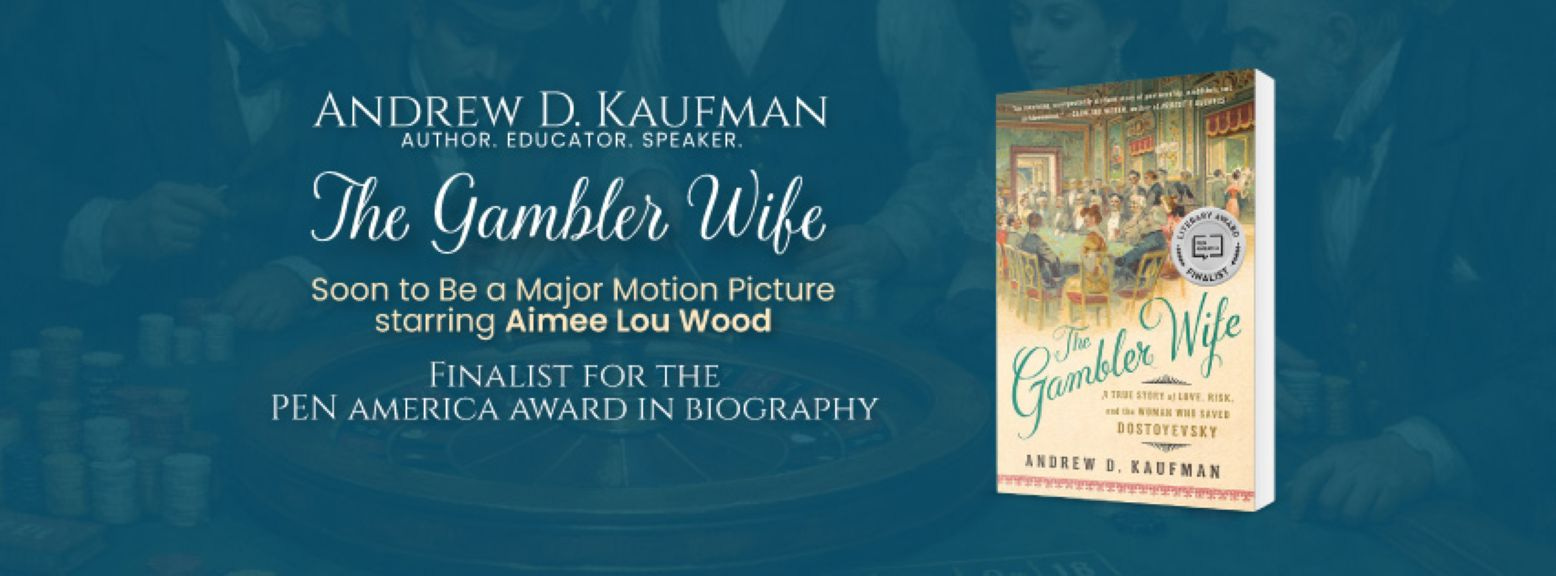
Many of the themes in this piece—identity, reinvention, and the possibility of change—also run through my book, The Gambler Wife: A True Story of Love, Risk, and the Woman Who Saved Dostoyevsky, a PEN finalist biography currently being adapted for film.


Beautiful story and oh so wonderful.
Oh, I love this story so much. What a powerful example of shifting self identity through language and experience. Thank you for sharing this.